Jan 21, 2026
Air leakage in nylon hose systems is one of those problems that seems small at first, yet quietly drives up energy costs, destabilizes machine performance, and creates endless maintenance work. In most industrial pneumatic systems, leakage does not happen randomly along the tube—it almost always appears at the connection between nylon tubing and the fitting.
For distributors, equipment engineers, purchasers, and factory managers, understanding why these leaks occur is more valuable than simply replacing parts. The causes are often basic, but rarely checked systematically.
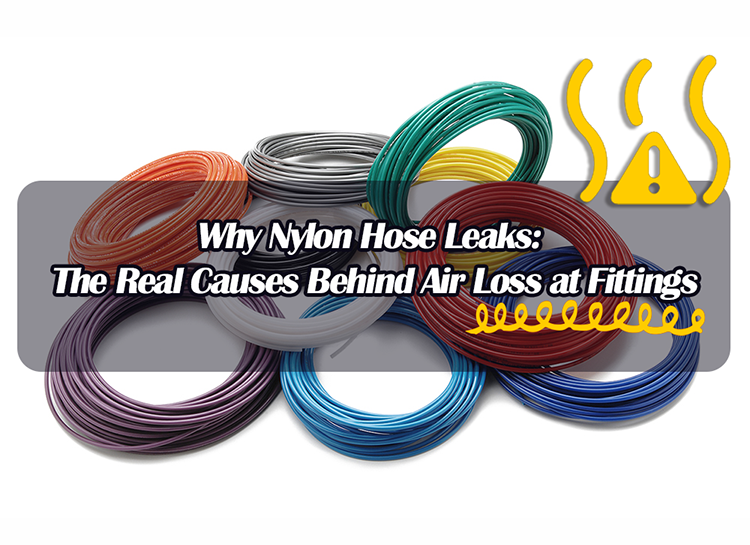
Before blaming the nylon air hose itself, the first step is always confirmation. Experienced technicians rely on three practical methods: listening for escaping air, applying water or soap solution, or observing pressure drop during idle states. These simple checks quickly reveal whether leakage comes from a fitting interface rather than valves or cylinders.
Once the leak point is confirmed, the real diagnosis begins—because replacing the hose alone often does not solve the problem.
One of the most common and overlooked causes is diameter mismatch. In the field, it is surprisingly easy to insert a metric nylon tube into an inch-based fitting. The tube may feel secure at first, but the seal is never reliable.
For example, a 6 mm PA tubing can sometimes be pushed into a 1/4" fitting due to tolerance overlap. However, the internal sealing ring is designed for a specific outer diameter. Under pressure or vibration, micro-gaps appear and air slowly escapes.
Key risk:
◆Initial installation appears normal
◆Leakage develops after pressure cycling
◆Frequent re-tightening does not help
For distributors and procurement teams, clear labeling and standardization of nylon tubing and fitting systems prevent this issue before it reaches the customer.
Push-in fittings rely on a clean, flat tube end to seal correctly. If the end of a plastic air hose tubing is cut with scissors, damaged by blades, or shows burrs, the sealing surface becomes incomplete.
Even minor bevels or rough edges can prevent the O-ring from contacting evenly. This results in slow leakage that worsens under pressure fluctuation.Best practice: Always cut nylon hose using a dedicated tube cutter to ensure a 90-degree, burr-free surface. This single habit eliminates a large percentage of connection leaks.
Nylon tubing is flexible, but not immune to deformation. When a nylon air hose is stored improperly, compressed under heavy loads, or bent tightly for long periods, its cross-section may become oval rather than round.
Once deformed, even a correctly sized tube will not seal evenly inside the fitting. Wall thickness variation further increases the risk, especially in low-pressure systems where sealing force is limited.
This issue is frequently misdiagnosed as “poor fitting quality,” when in fact the tubing itself has lost its geometric integrity.
In systems that require frequent disassembly—testing benches, modular equipment, or export machines—fittings may be reused many times. Each insertion and removal slightly wears the internal O-ring and collet teeth.
Over time, the fitting can no longer grip or seal the nylon tubing properly, even if the tube itself is new. This is especially common in low-cost fittings where elastomer quality is inconsistent.
Typical symptoms include:
◆Tube pops out under pressure
◆Leakage appears only after vibration
◆Same tube works in a new fitting
Replacing the fitting, not the hose, is often the correct solution.
Another frequently ignored detail is bending radius near the fitting. When a nylon hose is forced into an immediate bend at the fitting outlet, side-load is applied directly to the sealing interface.
This constant stress distorts the seal and accelerates wear on the O-ring. Over time, leakage appears even if the initial installation was perfect.
Maintaining a short straight section before any bend significantly improves long-term sealing reliability.
| Leak Cause | Typical Mistake | Corrective Action |
|---|---|---|
| Tube size mismatch | Metric tube in inch fitting | Match OD standards strictly |
| Rough tube end | Cut with knife or scissors | Use proper tube cutter |
| Tube deformation | Over-bending or compression | Replace tube section |
| Worn fitting seals | Repeated reuse | Replace fitting |
| Tight bend at fitting | No straight section | Add bend radius |
Air leakage in nylon tubing systems is rarely caused by one dramatic failure. It is usually the result of small details being overlooked during installation or maintenance. By understanding these causes and selecting nylon hose and fittings as a complete system rather than separate items, engineers and users can significantly reduce air loss, downtime, and long-term operating costs.
(FK9026)
 PVC Tubing vs Polyurethane Tubing: Choosing the Better Air Hose for Modern Pneumatic Systems
 Braided Polyurethane Tube for High Pressure Pneumatic Systems
 PUB Braided Polyurethane Tube vs Standard PU Tube: Durability in Automation Systems
 Food Grade Pneumatic Fittings: Why Full Stainless Steel One-Touch Fittings Matter in Hygienic Production Lines
 Brass vs Stainless Steel Fittings: Lifespan Comparison in Demanding Environments
You May Interest In


Jan 12, 2026 Blog
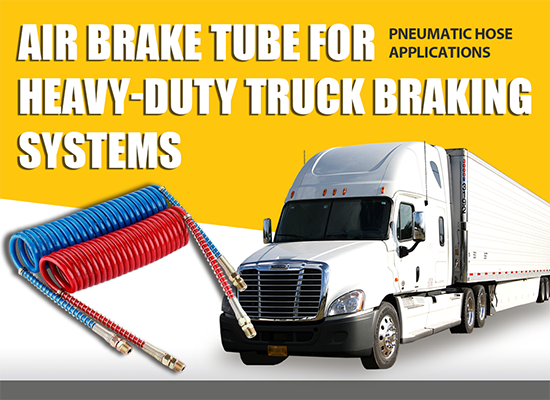
Air Brake Tube for Heavy-Duty Truck Braking Systems

Dec 26, 2025 Blog
What Is Vacuum and What Is a Vacuum System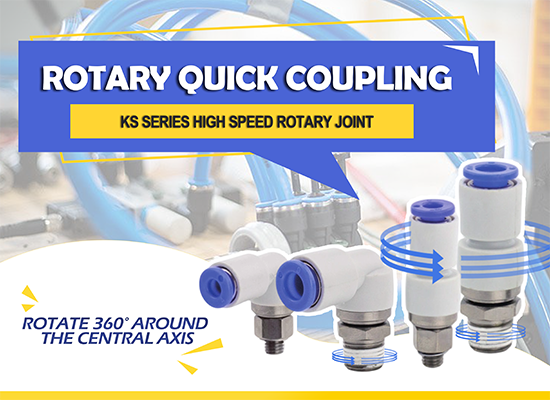

Get a free sample

Links: www.fescolo.com(Pneumatic)
FOKCA ©1998-2025 All Rights Reserved Sitemap