Feb 16, 2026
In pneumatic systems,SMC Standard Pneumatic One Touch fittings are widely trusted for their compact design and fast installation. Yet many engineers and distributors encounter the same issue: a tube that looks correct either leaks slowly or is difficult to insert. The reason is not installation skill—it is the extreme sensitivity of SMC Standard Pneumatic fittings to tube outer diameter (OD) tolerance.
This sensitivity is intentional. It comes directly from the sealing and gripping philosophy behind the SMC quick connector design.
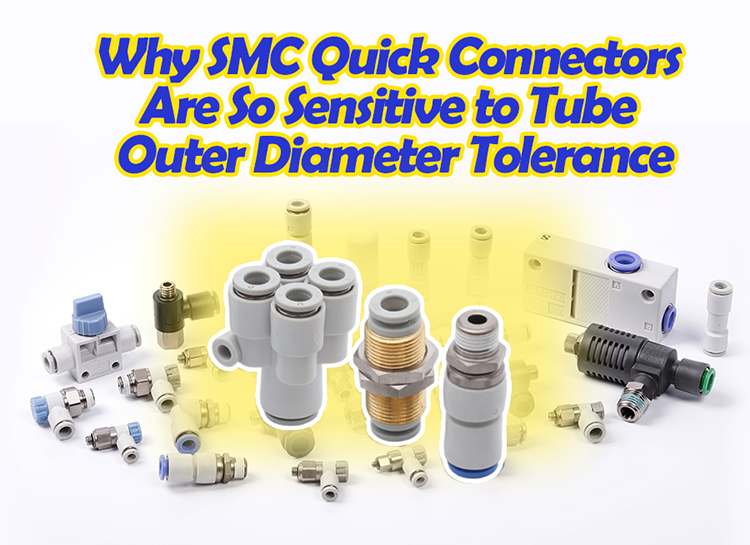
Unlike compression fittings, SMC quick connectors rely on a combination of an internal O-ring and a stainless-steel collet (gripping claw). These two components work together, but each reacts differently to tube OD variation.
The O-ring provides airtight sealing by radial compression, while the collet prevents axial pull-out. Both are designed around a very narrow OD window. When the tube sits perfectly in that window, the system works flawlessly—compact, leak-free, and tool-less.
The trade-off is tolerance sensitivity.
Many users assume problems come from switching between nylon tubing and PU tubing. In reality, material is secondary. The dominant factor is outer diameter consistency.
Even when two tubes are both labeled “6 mm,” their real OD can vary depending on extrusion stability, cooling process, and post-processing. SMC Standard Pneumatic fittings are designed to Japanese industrial tolerances, which are often tighter than those used by general-purpose tubing suppliers.
That mismatch explains why a tube may physically insert but fail under pressure cycling.
When the tube OD is slightly undersized, the collet can still grip it, giving the impression of a secure connection. However, the O-ring is not compressed enough to maintain a stable seal.
This leads to:
1.Micro-leakage that worsens over time
2.Pressure loss during idle states
3.Speed inconsistency in cylinders
These leaks are often misattributed to poor fitting quality, when the real cause is OD deviation of just a few hundredths of a millimeter.
Oversized tubes cause a different set of problems. The O-ring experiences excessive compression, while the collet teeth dig aggressively into the tube surface.
Common symptoms include:
1.Difficult or impossible insertion
2.Tube damage during installation
3.Collet wear after repeated insertion attempts
In production environments, this increases assembly time and leads to premature fitting replacement—an issue especially visible for distributors supplying OEM lines.
| Tube OD Condition | Installation Behavior | Long-Term Result |
|---|---|---|
| Within SMC tolerance | Smooth insertion | Stable sealing |
| Slightly undersized | Easy insertion | Slow air leakage |
| Slightly oversized | Hard insertion | Tube damage |
| OD inconsistent | Unpredictable | Field complaints |
This table highlights why two tubes with the same nominal size can behave very differently in the same SMC Standard Pneumatic One Touch connector.
Another hidden risk is mixing standards. A metric tube may appear to fit into an inch-based smc quick connector due to elastic deformation, but the internal O-ring is never truly matched.
This creates a false sense of compatibility:
◆Initial installation passes
◆Leakage appears after vibration or pressure cycling
◆Replacing the tube does not solve the issue
For procurement teams, this is a classic example of short-term convenience creating long-term cost.
Perfect 90° cuts, clean tube ends, and correct insertion depth are all important—but they cannot compensate for incorrect OD tolerance. When the tube geometry is wrong, even a brand-new SMC fitting will underperform.
This is why some OEMs report excellent results with SMC fittings in one project and persistent leaks in another, despite using the same model number.
Some applications require more flexibility—mixed tube suppliers, frequent maintenance, or global sourcing. In these cases, many engineers look for SMC-compatible pneumatic fittings that retain the same form factor but offer wider OD tolerance control.
Suppliers like FOKCA Automation focus on compatibility at the structural level while tightening control on tube OD matching and sealing behavior. The result is a fitting that installs like an SMC Standard Pneumatic fitting, but performs more consistently across varied tubing batches.
For distributors, this reduces returns. For OEMs, it stabilizes production. For end users, it simply means fewer leaks.
SMC quick connectors are not flawed—they are precise. Their sensitivity to tube outer diameter is the price of compact, high-performance sealing. Problems arise only when that precision is underestimated.
Understanding this interaction between tube OD, O-ring compression, and collet geometry allows engineers and purchasers to make better decisions—whether that means stricter tubing control or selecting a more tolerant, SMC-compatible alternative for real-world conditions.
In pneumatic systems, small dimensions create big consequences.
(FK9026)
 PVC Tubing vs Polyurethane Tubing: Choosing the Better Air Hose for Modern Pneumatic Systems
 Braided Polyurethane Tube for High Pressure Pneumatic Systems
 PUB Braided Polyurethane Tube vs Standard PU Tube: Durability in Automation Systems
 Food Grade Pneumatic Fittings: Why Full Stainless Steel One-Touch Fittings Matter in Hygienic Production Lines
 Brass vs Stainless Steel Fittings: Lifespan Comparison in Demanding Environments
You May Interest In


Sep 07, 2025 Blog
Rubber hose vs. PVC tubing How to choose?


Get a free sample

Links: www.fescolo.com(Pneumatic)
FOKCA ©1998-2025 All Rights Reserved Sitemap