Engineers who work with throttle valves rarely struggle with basic sizing. Port size, operating pressure, and thread type are usually clear from the datasheet. Problems appear later—during commissioning, after a few months of operation, or when the same machine behaves differently across markets. In many cases, the root cause is not wrong sizing, but overlooked parameters that quietly shape real performance.
For distributors, equipment engineers, and purchasing teams, understanding these details helps avoid returns, customer complaints, and repeated re-selection.
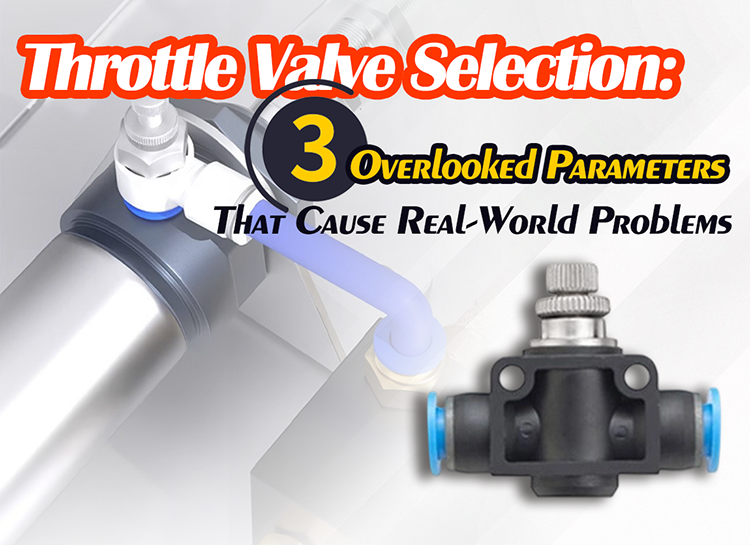
Adjustment Resolution: Why “Fine Control” Is Not a Given
In theory, every throttle valve pneumatic component regulates flow. In practice, the adjustment resolution—how precisely flow can be tuned—varies dramatically by internal structure.
Many low-cost pneumatic flow control valves use coarse needle threads. This makes adjustment fast, but unstable. A slight turn can change cylinder speed abruptly, especially in short-stroke or high-response applications such as pick-and-place units.
In contrast, fine-pitch needle designs allow stable micro-adjustment, which is critical when equipment must be tuned repeatedly during setup or product changeover. This difference rarely appears in catalogs, yet it strongly affects commissioning time and repeatability.
Practical insight: For distributors supplying OEMs, valves with higher adjustment resolution reduce after-sales support calls—an invisible but real cost.
Internal Leakage Under Low Pressure: The Silent Efficiency Killer
Datasheets typically specify maximum operating pressure, but rarely emphasize behavior at low working pressure. Many modern machines run at 0.3–0.4 MPa to save energy, especially in Europe and Japan.
At these pressures, internal leakage becomes significant. Poorly machined sealing surfaces inside a throttle check valve pneumatic unit may not fully close, causing slow cylinder creep or inconsistent speed.
This issue often gets misdiagnosed as a cylinder or valve problem, leading to unnecessary replacements.
Why it matters in real systems:
◆In vertical cylinders, leakage affects holding stability
◆In synchronized movements, it causes speed mismatch
◆In energy-optimized systems, it offsets compressed air savings
According to industrial pneumatic efficiency studies, micro-leakage can account for 5–10% air loss in low-pressure systems (source: industry energy audits).
Flow Direction Sensitivity: When Installation Orientation Changes Performance
Many engineers assume flow control valves behave symmetrically. However, most pneumatic flow control valves are optimized for one dominant direction, especially combined throttle-check designs.
If the internal check valve cracking pressure is too high, reverse flow may be delayed, affecting cylinder retraction speed. In high-cycle automation, this creates timing drift that accumulates over thousands of cycles.
This is particularly relevant when machines are mirrored or adapted for left-hand/right-hand layouts, where valve orientation changes but selection does not.
Design takeaway: Always verify effective flow coefficient in both directions, not just nominal flow rate.
Commonly Ignored Parameters vs. Real Impact
| Parameter Often Ignored | Why It’s Overlooked | Real-World Impact |
|---|---|---|
| Adjustment resolution | Not listed in datasheets | Speed instability, longer setup |
| Low-pressure sealing | Focus on max pressure | Air loss, cylinder creep |
| Directional sensitivity | Assumed symmetric | Timing drift, uneven motion |
| Needle vibration resistance | Only tested in lab | Speed fluctuation over time |
This gap between catalog data and field behavior explains why two throttle valves with similar specifications can perform very differently on the same machine.
Material Pairing Inside the Valve: More Than Corrosion Resistance
Material choice is often discussed only in terms of corrosion. However, internal pairing—needle vs. body material—affects wear, especially under frequent adjustment.
Aluminum-brass combinations may adjust smoothly at first but lose precision over time. Hardened stainless needle designs maintain consistency longer, particularly in OEM machines shipped globally, where users adjust speed on site.
For distributors, durability here directly translates into brand reputation, even if the valve itself is a small component.
System Thinking: From Single Valve to Consistent Platform
Experienced engineers eventually move from component selection to platform consistency. Using different throttle valve designs across machines complicates tuning, spare parts management, and training.
A standardized throttle valve pneumatic platform with predictable behavior simplifies:
◆Machine commissioning
◆Documentation and manuals
◆Customer training and support
This is where OEM-oriented suppliers add value beyond price.
Choosing a throttle valve is rarely about one parameter. It’s about understanding how small, overlooked details affect long-term performance, energy efficiency, and customer experience. Engineers who look beyond the obvious specs make fewer corrections later—and that advantage compounds over every machine shipped.
(FK9026)