Jan 22, 2026
In compact pneumatic installations, it is very common to see tubing bent sharply right after an SMC Standard Pneumatic One Touch Fitting. From an installation point of view, this seems efficient and space-saving. From a mechanical and sealing perspective, however, this practice often shortens sealing life and becomes a hidden cause of slow air leakage. The reason is not the tubing itself, but how side load interacts with the internal sealing structure of a pneumatic push in fitting.
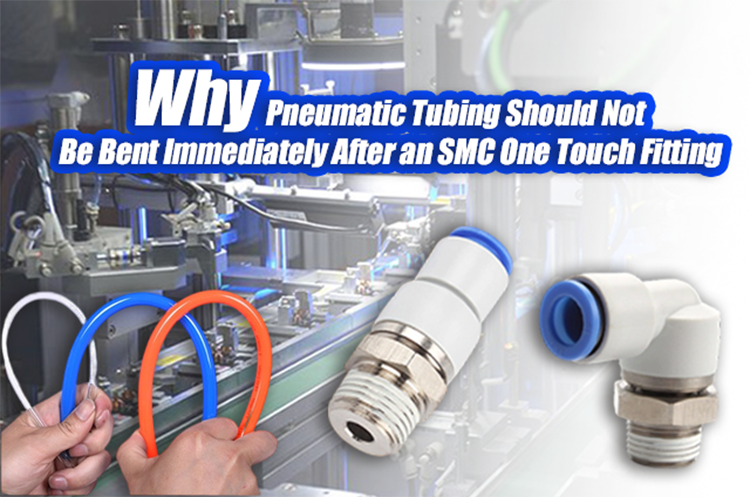
An SMC quick coupling seals by combining two actions: a stainless-steel collet grips the outer diameter of the tube, and an internal elastomer seal provides radial compression. This system works best when the tube is inserted straight and remains axially aligned with the fitting. Under these conditions, sealing pressure is evenly distributed around the tube circumference, and the elastic seal maintains long-term stability.
Problems arise when external forces disturb this balance.
When pneumatic tubing is bent immediately after insertion, it introduces constant lateral force at the sealing point. Instead of axial alignment, the tube now pulls sideways against the collet and sealing ring. This side load does not cause instant failure, but it changes how the seal works.
Over time, side load leads to:
1.Uneven compression of the sealing ring
2.Localized stress on one side of the seal
3.Micro-movement between tube and seal during pressure cycles
This condition is known as seal eccentric loading, and it significantly reduces sealing life in push-in fittings.
In a pneumatic quick coupler, the elastomer seal is designed to deform uniformly. When the tube is bent sharply, one side of the seal remains over-compressed while the opposite side relaxes slightly. During repeated pressure changes, this imbalance accelerates compression set in the seal material.
The result is not sudden air loss, but:
1.Progressive loss of elastic recovery
2.Formation of micro-gaps along the tube surface
3.Gradual pressure drop that is difficult to detect
This explains why leakage near SMC One Touch fittings often appears weeks or months after installation, especially in compact machines.
PU tubing, commonly used for flexibility, amplifies this effect. Its lower stiffness allows greater bending-induced displacement at the fitting entrance. While SMC pneumatic fittings are compatible with PU tubing, sharp bends increase side load magnitude, accelerating seal wear compared to stiffer nylon tubing.
The issue is not material incompatibility—it is mechanical geometry under load.
To protect sealing performance, a short straight section should always be maintained after the fitting before bending the tube.
| Tubing OD | Recommended Straight Length |
|---|---|
| ≤ 6 mm | ≥ 20 mm |
| 8–10 mm | ≥ 30 mm |
| ≥ 12 mm | ≥ 40 mm |
These values are based on general pneumatic installation practice and help ensure axial alignment at the sealing point.
When space constraints make straight routing impossible, changing the fitting type is a better solution than forcing the tube to bend.
In compact layouts, the following options significantly improve reliability:
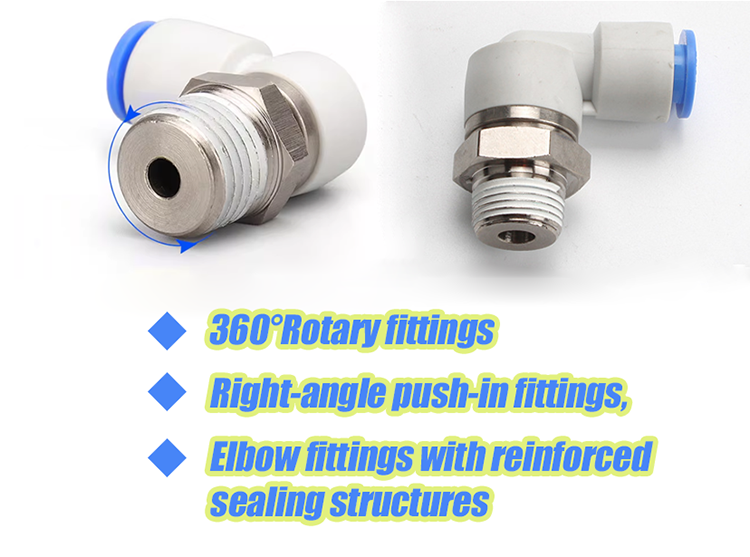
◆Right-angle push-in fittings, redirecting flow without side load
◆Swivel or rotary fittings, allowing the tube to align naturally
◆Elbow fittings with reinforced sealing structures
These designs maintain proper sealing geometry while accommodating tight routing, outperforming straight SMC Standard Pneumatic One Touch Fittings in confined spaces.
A simple rule applies across most pneumatic systems:
1.Straight fitting + straight tube section for open layouts
2.Elbow or swivel fitting for compact or directional changes
This approach reduces leakage risk, lowers maintenance frequency, and extends fitting service life—without changing tubing or system pressure ratings.
Air leakage near fittings is rarely caused by poor product quality. More often, it results from side loads introduced by layout decisions. Push-in fittings are optimized for speed and simplicity, not for resisting continuous bending force at the sealing point.
Selecting the right fitting geometry—especially in space-limited equipment—is not an upgrade; it is good pneumatic design practice. For distributors, engineers, and end users alike, understanding this principle prevents small layout decisions from becoming long-term reliability problems.
(FK9026)
 PVC Tubing vs Polyurethane Tubing: Choosing the Better Air Hose for Modern Pneumatic Systems
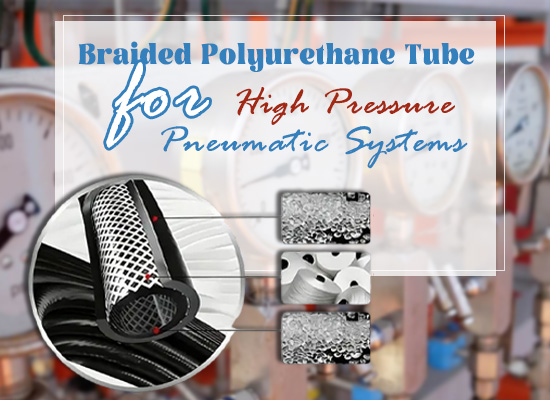 Braided Polyurethane Tube for High Pressure Pneumatic Systems
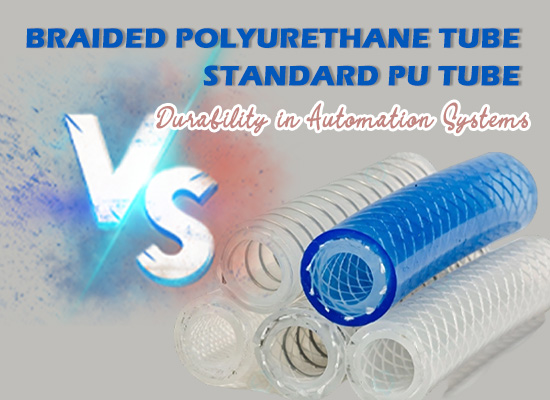 PUB Braided Polyurethane Tube vs Standard PU Tube: Durability in Automation Systems
 Food Grade Pneumatic Fittings: Why Full Stainless Steel One-Touch Fittings Matter in Hygienic Production Lines
 Brass vs Stainless Steel Fittings: Lifespan Comparison in Demanding Environments
You May Interest In

Get a free sample

Links: www.fescolo.com(Pneumatic)
FOKCA ©1998-2025 All Rights Reserved Sitemap