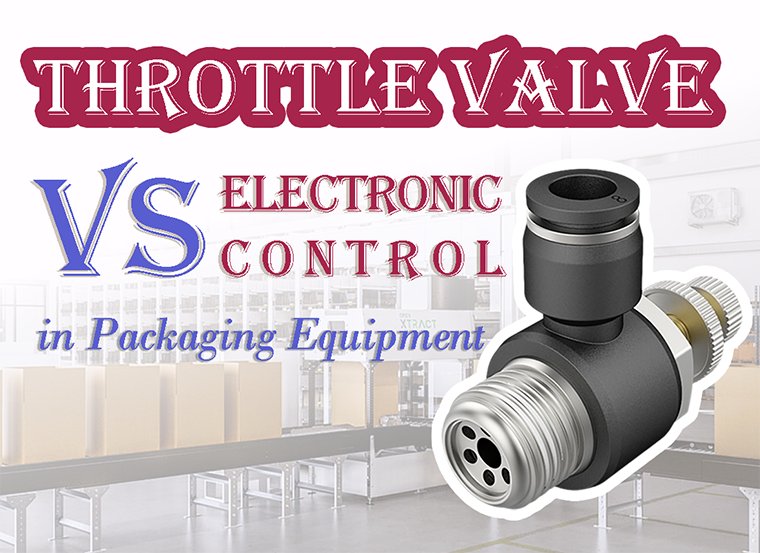
In high-speed packaging lines, motion stability matters more than theoretical precision. While electronic control systems offer programmability, Throttle Valve , solutions remain widely used because they deliver stable airflow regulation with lower complexity. For distributors and equipment engineers, understanding why mechanical flow control still dominates helps optimize both cost structure and system reliability.
Cost Efficiency: Why Throttle Valve Systems Remain Practical
Packaging machinery operates with tight margins. Adding servo control or electronic proportional systems significantly increases component cost and commissioning time. In contrast, a Throttle Valve provides adjustable airflow using a simple needle structure, requiring no additional controller.
For standard pneumatic cylinders, mechanical flow regulation reduces total motion control cost by 20–40% compared to electronic speed modules (industry equipment cost benchmarks). This difference becomes substantial when a filling or sealing line includes dozens of actuators.
From a procurement perspective, fewer electronic components mean fewer failure points and less inventory complexity. That is why many OEMs still pair cylinders with manual Flow Control Valve units for secondary motion adjustment.
Adjustment Speed: Faster Commissioning on the Production Floor
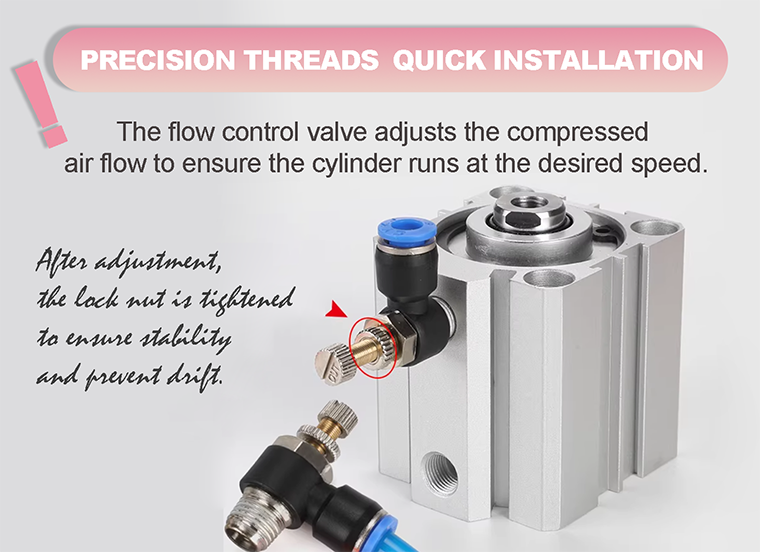
When a packaging machine is installed, engineers often fine-tune cylinder speed directly on site. With a Throttle Check Valve, adjustment takes seconds—turn the knob, observe movement, lock the setting.
Electronic control requires parameter programming, wiring verification, and sometimes firmware calibration. In time-sensitive production environments, mechanical flow control improves commissioning efficiency.
Less programming means faster machine handover.
This is particularly relevant for vertical form-fill-seal systems and cartoning machines, where airflow balance affects sealing timing.
Maintenance Simplicity and Long-Term Reliability
Packaging environments expose components to dust, humidity, and vibration. Electronic modules can suffer from signal instability, while a Throttle Valve operates purely through mechanical restriction.
Routine maintenance typically involves:
◆Cleaning the valve body
◆Checking for blockage
◆erifying one-way function in a Throttle Check Valve
No software diagnostics are required. For factory managers, this translates into predictable maintenance schedules and lower downtime risk.
When paired with quality air preparation units such as Pneumatic Air Filters the lifespan of a mechanical flow control component increases significantly.
Flow Control Valve Integration with Standard Cylinders
In most packaging systems, speed control is required only for extension or retraction, not for dynamic closed-loop positioning. A Flow Control Valve mounted directly on the cylinder port offers localized speed tuning without affecting the entire circuit.
Below is a simplified comparison:
| Aspect | Throttle Valve | Electronic Control Module |
|---|---|---|
| Initial Cost | Low | High |
| Installation | Direct mount | Wiring + Programming |
| Adjustment | Manual, instant | Parameter-based |
| Maintenance | Mechanical cleaning | Electrical diagnostics |
| Downtime Risk | Low | Medium |
For machines using Standard Pneumatic Cylinders direct-mount flow control remains the most space-efficient approach.
Standardization Benefits for Distributors and OEMs
From a distribution perspective, standardized Throttle Valve models compatible with ISO cylinder ports simplify inventory planning. Mechanical flow control devices generally follow internationally recognized dimensional practices aligned with guidelines from the International Organization for Standardization.
This allows distributors to stock universal models instead of multiple electronic variations.
Standardized flow control reduces SKU complexity and improves turnover.
Selecting the Right Throttle Check Valve for Packaging Lines
Although mechanical control is simple, proper sizing remains essential. Engineers should consider:
1.Operating pressure range (typically 0.4–0.8 MPa)
2.Required speed stability
3.One-way flow function requirement
4.Installation space
For high-cycle packaging equipment, selecting a durable needle mechanism and stable sealing material prevents drift over time. Integrating the valve with compatible Pneumatic Solenoid Valvesensures consistent airflow switching.
In practical terms, packaging machinery prioritizes reliability, fast setup, and manageable cost over complex programmability. That is why Throttle Valve and Flow Control Valve solutions continue to outperform electronic alternatives in real-world production environments.
For distributors and equipment engineers seeking dependable pneumatic components, standardized mechanical flow control remains a commercially and technically balanced choice.
(FK9026)