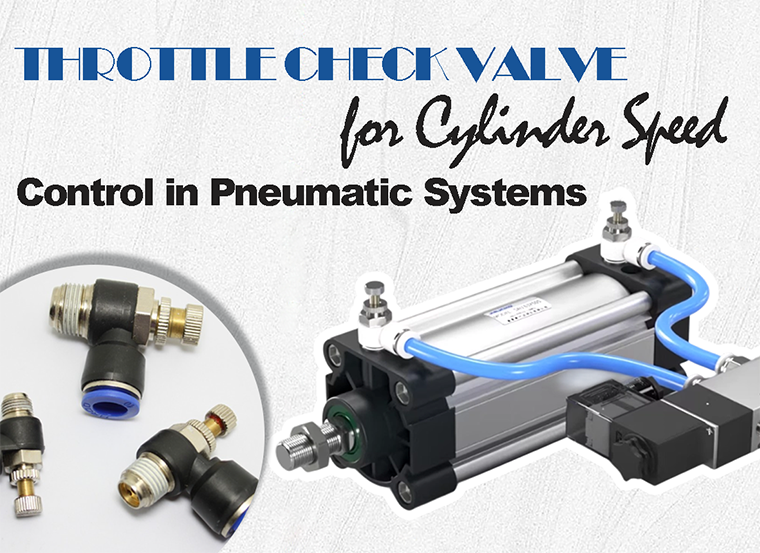
In pneumatic automation, cylinder speed stability often determines product quality and cycle time consistency. While many engineers initially consider a standard Throttle Valve or Two-way Flow Control Valve, practical experience shows that a Throttle Check Valve provides more stable and predictable cylinder motion. Understanding the difference between inlet throttling and exhaust throttling is essential for equipment engineers, distributors, and maintenance teams aiming to avoid unstable motion and response delay.
Why Exhaust Control with a Throttle Check Valve Improves Stability
Cylinder speed can be controlled either by restricting the incoming air (meter-in) or the outgoing air (meter-out). The choice directly affects motion smoothness.
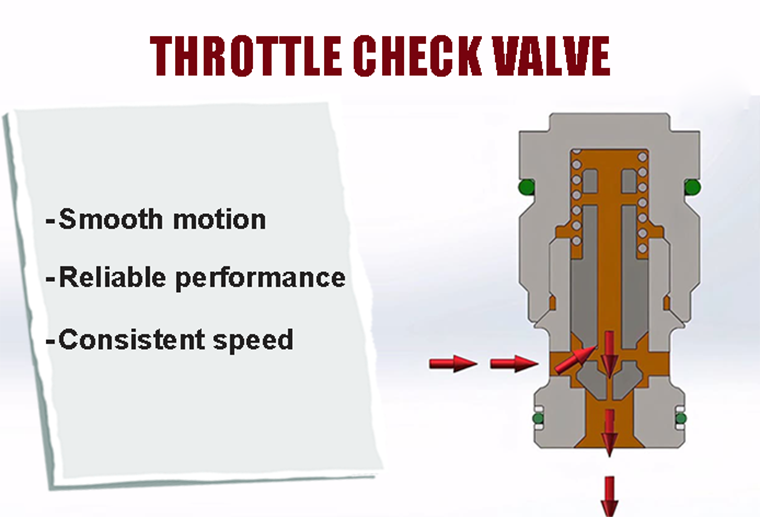
A Throttle Check Valve typically allows free airflow in one direction and controlled restriction in the other. In most industrial applications, it is installed for exhaust throttling (meter-out control).
When restricting exhaust instead of supply:
◆Back pressure stabilizes piston movement
◆External load variations have less impact
◆Speed remains more consistent under fluctuating conditions
Meter-out control provides smoother and more stable cylinder motion.
In contrast, inlet throttling with a simple Flow Control Valve may result in speed variation if load changes suddenly, especially in vertical installations.
For deeper understanding of air supply stability, engineers often review related guidance on pneumatic air preparation units
Risks of Using Two-way Flow Control Valve for Both Directions
A Two-way Flow Control Valve restricts airflow in both directions. Although it may seem convenient, double-direction throttling can introduce instability in certain conditions.
When both inlet and exhaust are restricted:
◆Pressure buildup becomes unpredictable
◆Cylinder response may lag
◆Acceleration and deceleration become inconsistent
In high-frequency reciprocating systems, this dual restriction may cause cumulative delay. Each cycle slightly alters chamber pressure equilibrium, leading to uneven motion over time.
Double throttling can reduce responsiveness in dynamic systems.
According to pneumatic control principles outlined by ISO air system guidelines, consistent exhaust control is preferred for predictable motion in most industrial pneumatic applications.
High-Frequency and Variable Load Applications: Where Double Throttling Fails
In packaging lines, pick-and-place units, and automated assembly machines, cylinders operate at high cycle rates. Under these conditions, a standard Throttle Valve limiting both directions may cause:
◆Delayed extension under increasing load
◆Slower retraction during pressure recovery
◆Overheating due to restricted airflow
For example, in high-speed labeling equipment, engineers observed response lag when using bidirectional throttling. Switching to a Throttle Check Valve improved repeatability and reduced cycle variation.
In vertical lifting applications with changing loads, meter-in control may allow gravity to accelerate the piston unexpectedly. Exhaust control prevents this by maintaining back pressure.
Practical Comparison of Flow Control Methods
Below is a simplified engineering comparison:
| Control Method | Stability | Response Speed | Suitable Applications |
|---|---|---|---|
| Meter-in (Inlet Throttling) | Medium | Sensitive to load | Light horizontal motion |
| Meter-out (Throttle Check Valve) | High | Stable | Vertical or variable load |
| Two-way Flow Control Valve | Variable | May lag at high frequency | Low-speed, stable load systems |
For high-speed or load-sensitive systems, exhaust throttling is generally the safer choice.
Engineers designing automated motion systems often combine a Throttle Check Valve with properly sized cylindersto optimize overall response.
When Should You Avoid Two-way Flow Control Valve?
There are scenarios where a Two-way Flow Control Valve is not recommended:
◆High-frequency reciprocating cylinders
◆Systems with rapidly changing loads
◆Precision positioning requirements
◆Vertical motion under gravity influence
In these cases, double throttling may introduce micro-delays that accumulate over multiple cycles. The result is unstable speed control and increased wear.
Cylinder speed control is not only about reducing airflow—it is about controlling motion behavior under real load conditions. Selecting the correct Throttle Check Valve configuration ensures smoother actuation, improved repeatability, and lower long-term maintenance risk in pneumatic automation systems.
(FK9026)