In pneumatic automation, low-speed control often looks simple but behaves unpredictably in practice. Many engineers notice that cylinders move smoothly at medium speed, yet begin to hesitate, jump, or creep when slowed down. The Throttle Valve is usually the first component blamed—and for good reason. At very small openings, flow control becomes highly sensitive, amplifying the effects of air compressibility and internal friction inside the actuator.
Low-Speed Operation Starts with Unstable Airflow
When a pneumatic cylinder runs at low speed, the airflow required is minimal. Under these conditions, Speed Controllers and throttling elements operate close to their minimum effective range. Small adjustments in valve opening can lead to disproportionate changes in flow rate.
At low flow, compressed air no longer behaves linearly. Pressure builds up behind the piston, overcomes static friction, and then releases suddenly—causing the characteristic stick-slip or creeping motion.
This effect is far less noticeable at higher speeds where airflow is continuous and stable.
Why Throttling at Small Openings Amplifies Air Compressibility
A Throttling Valve works by restricting flow area. At small openings, the effective orifice becomes extremely sensitive to pressure fluctuations. Any minor change in upstream or downstream pressure results in uneven airflow.
In pneumatic systems, air acts like a spring. The smaller the flow passage, the more pronounced the pressure buildup becomes. Once the force exceeds piston friction, movement resumes abruptly. This cycle repeats, producing unstable motion that is especially visible during slow positioning or gentle clamping operations.
Control-In vs Control-Out: Why Exhaust Throttling Matters
Many engineers discover that switching to a Control-out Throttle Valve improves low-speed stability. Instead of restricting incoming air, control-out throttling regulates exhaust flow, allowing pressure to build more gradually on the driving side.
Exhaust-side throttling reduces sudden pressure release, helping maintain a more consistent piston force. This method is widely used in precision automation where smooth deceleration and stable low-speed travel are required.
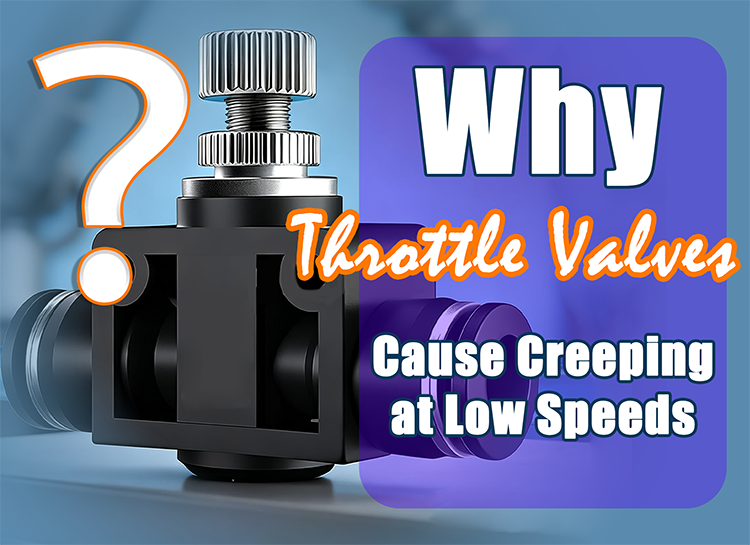
Needle Structure and Fine Thread Adjustment Make a Difference
Not all throttle valves behave the same. Valve design plays a critical role at low speed. Needle-type flow control structures provide a more predictable flow curve compared to blunt or flat throttling elements.
Equally important is the adjustment mechanism. Fine-pitch threads allow smaller, more repeatable adjustments, giving engineers better control over micro-flow changes. This is why Pneumatic Throttle Valve models designed for precision often feature long adjustment ranges and fine-thread knobs rather than coarse screws.
Push-In Throttle Valves vs Precision Flow Controllers
Standard Push-in Throttle Valve designs are optimized for convenience and compact installation. They perform well in general-purpose automation but may struggle in ultra-low-speed applications.
| Valve Type | Low-Speed Stability | Adjustment Precision | Typical Use |
|---|---|---|---|
| Push-in Throttle Valve | Medium | Medium | General automation |
| Needle-Type Speed Controllers | High | High | Precision positioning |
| Control-out Throttle Valve | High | Medium–High | Smooth cylinder motion |
Based on common pneumatic application practices.
This comparison highlights why engineers often upgrade valve selection rather than over-adjusting standard components.
Selecting Throttle Valves for Stable Low-Speed Control
For distributors and system designers, the takeaway is practical. Creeping is not always a cylinder problem—it is often a flow control limitation. When low-speed stability matters, choosing valves with needle structures, fine-thread adjustment, and control-out configuration significantly improves performance.
In fixed automation systems, many OEMs specify precision Speed Controllers specifically rated for low-flow stability, rather than relying on basic throttling valves. This approach reduces commissioning time and avoids repeated field adjustments later.
Practical Insight for Engineers and Buyers
Low-speed creeping is a natural consequence of air compressibility combined with coarse flow control. Understanding how throttle valve design interacts with pneumatic physics allows better component selection from the start.
When smooth motion, repeatability, and fine control are critical, investing in precision-oriented Throttle Valve series is not an upgrade—it is a necessity for reliable pneumatic performance.
(FK9026)